A Novel Is Too Long to Keep in Your Head. Keep It Here.
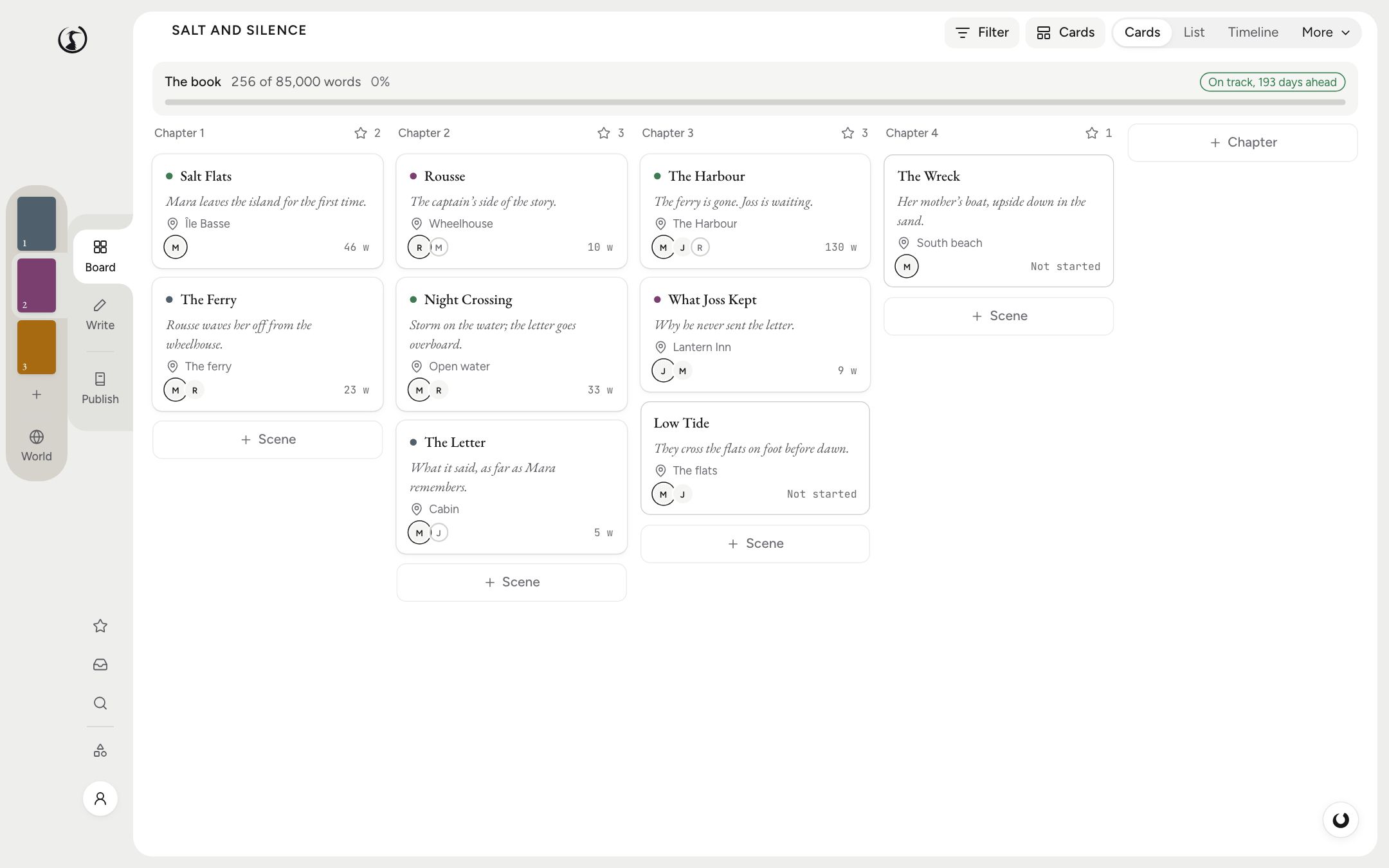
Novels rarely go wrong on page one. They go wrong somewhere past 40,000 words, when the book stops fitting in your head. Shiro is novel writing software for that stretch: your scenes on a board, your people and places in a World, your earlier versions kept, all in plain files on your computer.
What Happens Around Word 40,000
A short story can be held in the mind all at once. A novel can’t, and you rarely notice the moment you lose your grip on it. You write a scene where Anna confronts her brother about the letter, then can’t remember whether she has read the letter yet or whether you only meant her to. You cut a chapter on Sunday, and on Wednesday you realise it held the only mention of the key. The subplot with the landlord goes quiet for ninety pages and nobody files a report.
The usual defence is one long Word file and a second document of notes, accurate as of last autumn. It holds until the first big structural change. After that you’re scrolling through 300 pages for a paragraph you know exists, in a chapter that used to be somewhere else.
Keeping the Shape
A Shiro book is a set of scenes inside chapters, and the Board shows them as cards. Drag a card and the scene moves in the manuscript, so there’s no outline to fall out of step with the book. The Grid view puts plotlines in rows, which is how the landlord’s ninety missing pages become visible: as an empty row. The Timeline sorts scenes by when they happen, for the first time you tell something out of order and lose track of what day it is in the story.
If you plan, Save the Cat, three acts and a dozen others can lay their beats over your cards. If you don’t, the cards appear as you write and the Board can wait until you need it.
Keeping the Facts
Characters, places and events go in the World. Entries connect to the scenes that name them by whole-word matching, on your own computer, with no AI involved, so opening Anna shows every scene she’s in. Her rank, her address and whether she’s still speaking to her brother can each change at a given point in the story, and the World remembers which value holds where.
Continuity checks are ordinary code: someone in two places at once, someone on stage after their own funeral, story time running backwards, a journey too quick for its distance. They can only check what the book has told them, so they get more useful as you fill in where and when your scenes happen.
Keeping What You Cut
Every draft contains something you’ll want back. Shiro takes snapshots on its own: before a scene’s first change of the day, after each 30 minutes of active writing, and before any save that removes more than half a scene. Cut passages can wait in the Stash. And if you can’t decide whether a chapter belongs in first person, write it both ways as named alternatives, compare them, and settle when you know.
Where the Book Lives
A project is a folder of Markdown files with names like 01 The Harbour.md, which any text editor can open. The AI, also called Shiro, is optional. It can run on your own computer, use your own API key, go through Shiro Cloud, or stay switched off.
So Is This the Best App to Write a Novel?
There isn’t a best one, and any page saying otherwise was written by the app’s maker. So was this one. Scrivener has nearly twenty years of courses and forum answers behind it, and it handles screenplays, which Shiro doesn’t. Shiro is newer, free on your computer, and keeps your book in files you can read without it. Our guide to novel writing software goes through the field by need, including the needs we don’t serve. If your current setup keeps getting you to the end of books, keep your current setup.
The Questions People Ask
Is Shiro free for writing a novel?
The desktop app is free on your computer, with no account. The paid part is Shiro Cloud: sync, the web app, co-authors and hosted AI. The pricing page has the details.
Can I bring in a novel I’ve already started?
Yes. Shiro imports Scrivener 3 projects, Word files, Novelcrafter projects, Markdown folders and plain text. Import works on a copy, so your originals stay as they were.
Do I have to outline first?
No. Every scene gets a card as you write it, so a writer who plans and a writer who doesn’t end up with the same board. Structures such as Save the Cat are there if you want them, and they never change your text.
What does it run on?
Mac, Windows and Linux, offline and with no account. There’s also a web app for cloud projects, which needs a sign-in.