For Books Where Somebody Is Going to Check.
Research is the lens for non-fiction and memoir, in the place World takes for fiction. It holds your sources, the PDFs you read them in, the citations in your text, and a status on every claim: verified, disputed or still needing a source.
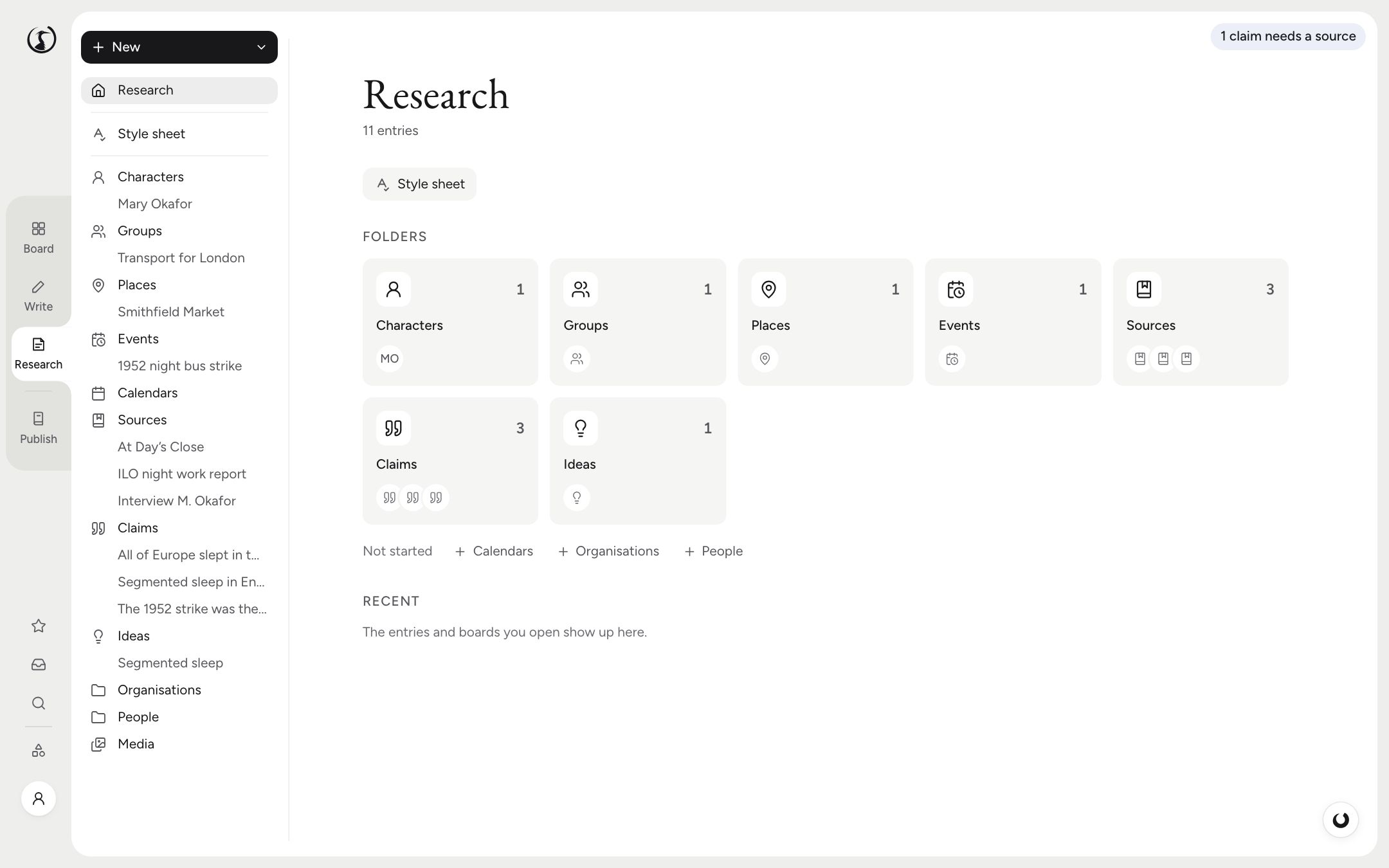
A Source Remembers Where You Used It
Add a source by DOI, ISBN or URL. Shiro asks doi.org or Open Library for the details, or reads the web page, and it does this only when you click Look up. Paste BibTeX, RIS or CSL JSON, the way Zotero exports them, and a whole list comes across. A source with no DOI, such as your aunt, can be filled in by hand.
Each source shows how many times the book cites it, and each highlight shows the scene it ended up in. For a web page, you can keep a copy as it looked on the day, which is worth doing, since the internet makes no promises to your footnotes.
Read the PDF Here, and Quote From It by Dragging
Attach a PDF to a source and read it in Shiro, beside your draft if you like. Highlights come in four colours with four meanings: quote, evidence, to check and idea. Any of them can carry a note.
Drag a highlight into your text and it lands as a quotation with its citation already attached. If page 1 of the PDF is really page 245 of the journal, tell Shiro once, and the page numbers you cite will be the printed ones.
Citations That Survive You Changing Your Mind
Citations sit in the text the way Pandoc reads them, like [see @ekirch2005, p. 301], and come out in Chicago notes and bibliography, Chicago author-date, APA 7, MLA 9 or Harvard. Switching style is a setting. A citation stores the source’s key, not a copy of its text, so when you find the misspelled author in the source, every citation of it is fixed at once. Note numbers are worked out at export, so adding one in your second chapter renumbers nothing by hand, and the bibliography comes with the export.
Those five styles are the list. Shiro can’t read custom CSL files yet, so if your publisher’s house style is something else, you’ll be adjusting by hand at the end.
Claims, and How Many You Can Defend
A claim is a statement your book makes, written down as its own entry with sources behind it. You mark it verified or disputed; with no source attached, it counts as needing one. Shiro keeps a running total of those.
That number is most useful well before the proofs, which is a bad moment to remember that the statistic in your second chapter came from a podcast. When the draft has settled, a fact-check pass goes through the book scene by scene: every figure and date has a source, quotes match word for word, names and titles are spelled right, nothing is left marked to check. Non-fiction projects start with it, alongside passes for the argument and for clarity.
Memoir Has Odd Sources
A memoirist’s evidence is letters, diaries, a shoebox of photographs, and an interview with the brother who remembers it differently. They all go in as sources, and a scanned letter opens like any other PDF.
A memoir project also starts with a truth and consent pass, whose checklist is short and uncomfortable: events happened as told, or the book says so; every real person is shown fairly; consent was asked where it should be; names were changed where needed, and changed consistently.
The Questions People Ask
Is Shiro a citation manager?
For the sources of the book you’re writing, yes. You add them by DOI, ISBN or URL, or paste BibTeX, RIS or CSL JSON, and cite them from the text.
Do I still need Zotero?
If you keep a library of thousands of papers across a career, keep Zotero and paste in what each book needs. Shiro holds one book’s sources, not a life’s reading.
Which citation styles are there?
Chicago notes and bibliography, Chicago author-date, APA 7, MLA 9 and Harvard. Custom CSL files aren’t supported.
Does Shiro look anything up without asking?
No. A DOI, ISBN or URL lookup goes out only when you click Look up. Sources you enter by hand or paste in make no request.